Best Books for Political Science Optional UPSC 2027
A curated, paper-wise list of the best books and resources for the PSIR optional — political theory, Western and Indian political thought, comparative politics, and international relations.
In-depth analyses, strategy guides, and current affairs breakdowns written by practitioners, not aggregators.
Expert analysis and strategy articles for UPSC preparation.

A curated, paper-wise list of the best books and resources for the PSIR optional — political theory, Western and Indian political thought, comparative politics, and international relations.

A day-by-day 90-day plan for UPSC Essay preparation — building the foundation in month one, writing skills in month two, and exam-oriented practice in the final month before Mains.

A practical comparison of Political Science (PSIR) and Sociology as UPSC optionals — syllabus nature, GS overlap, current affairs use, and a five-factor framework for choosing between them.

A step-by-step guide to preparing for the UPSC Essay paper in 2027 — understanding the pattern, building a knowledge base, structuring essays, and avoiding the mistakes that quietly cap scores.

Looking for a UPSC Essay preparation course in India? This beginner's guide covers why the Essay paper matters, what a structured course should include, and how to build writing skills from scratch.

Is a UPSC Essay course with personal mentorship worth it? A look at what individual feedback, customised improvement plans, and regular practice actually add over self-study.

Essay topics for UPSC Mains 2027 grouped by theme — governance, economy, society, environment, science and technology, ethics, and international relations — paired with a five-step writing framework.

A proven UPSC Essay writing strategy for 150+ marks — topic analysis, brainstorming, structure, examples, balance, and language, with the common mistakes that quietly cap an essay's score.

What to look for in the best PSIR Optional coaching for UPSC 2027 — faculty, study material, structured course plans, answer-writing practice, and personalised mentorship, explained.

A step-by-step guide to UPSC Mains answer writing — syllabus mapping, PYQ analysis, a quick answer framework, timed practice, and the value-additions that lift a good answer to a high-scoring one.

A practical PSIR answer-writing strategy for UPSC Mains — question analysis, structured introductions and bodies, thinkers and current affairs integration, and the mistakes that quietly cost marks.

The best PSIR books and resources for UPSC 2027 — standard texts by paper and topic, current affairs sources, and answer-writing material to build a focused, high-yield reading list.

A complete Political Science Optional preparation roadmap for UPSC 2027 — syllabus breakdown, a five-step preparation plan, study schedules, and how mentorship keeps preparation on track.

A complete PSIR optional strategy for UPSC 2027 — beginner fundamentals, intermediate note-making and current affairs integration, and advanced answer-writing and mock-test practice.

Join the Political Science Optional Course for UPSC 2027 at Roundtable IAS — a complete beginner's guide covering syllabus, roadmap, current affairs integration, and expert mentorship.

What is a union territory and how does it differ from a state? A clear breakdown of Articles 239-241, Article 3-4, Delhi, J&K, Ladakh, and India's 28 states, 8 UTs.

A complete UPSC guide to the Fundamental Duties of the Indian Constitution under Article 51A — origin, list, amendments, enforceability, and case laws.

A precise UPSC-focused guide to the fundamental rights of the Indian Constitution — Articles 12-35, six categories, key amendments, and landmark cases explained.
Taiwan holds 68% of global chip foundry capacity and China controls up to 90% of rare earth processing — two single points of failure that turn out to be interdependent, with 32 years of trade data proving China's REE export curbs function as deliberate geopolitical leverage.

A precise, stage-by-stage breakdown of the syllabus of UPSC Civil Services Exam 2026 — Prelims, Mains, and Interview marks, papers, and weightage explained.

China's 2025 rare earth export curbs were the trigger, not the story. This forecast piece looks a decade out — to permanent supply-chain regionalization, a $10 billion materials-science race, and weapons redesigned around scarcity by 2030-2035.

Confused about the full form of IAS and how it differs from UPSC? Get the precise constitutional, historical, and structural facts every serious aspirant must know.

Beyond the original April 2025 shock, defence primes and allied governments have spent over a year building a permanent industrial response — equity stakes in mining firms, AUKUS and Quad minerals pacts, 2030 domestic-content mandates, and multi-year stockpiling rules. For UPSC aspirants, this is where the story becomes GS-3 industrial policy and GS-2 alliance architecture, not just a supply-shock headline.

A complete, accurate guide to previous years question papers of UPSC — official PDF sources, Prelims and Mains structure, 2026 dates, and how to use PYQs strategically.

A Virginia-class submarine carries 4,600 kilograms of rare earth elements, an Arleigh Burke destroyer 2,600, and an F-35 fighter jet 418 — and the United States sources 80% of these imports from China. A platform-by-platform look at what America's military hardware actually needs, and where it falls short.

A month-by-month UPSC Mains preparation strategy after Prelims 2026 — DAF-I deadlines, paper-wise marks structure, and a week-by-week plan for Essay, GS, and Optional.

Saudi Arabia and Iran ran two opposite niche-diplomacy strategies in the Gaza war and both were sidelined by US intervention — a PSIR Paper II framework for turning this case into a theory-application answer, not a current-affairs summary.

Master the ethics case study UPSC aspirants dread most — structure, past themes, common errors, and a model-answer framework for GS Paper IV Section B.

Women make up half of India's population but generate just 18% of its GDP, with female labour force participation stuck at 45.9% and over 90% of working women trapped in informal jobs — McKinsey pegs the cost of this gap at $2.5 trillion in lost growth.

A decade-by-decade UPSC essay PYQ analysis (2013-2026) covering paper format, recurring themes, and 2025's actual topics to build a sharper Essay strategy.

India holds the world's fifth-largest rare earth reserves and is the second-largest global yttrium supplier, yet it imported 460 tonnes of rare earth magnets in 2024, almost entirely from China. This piece traces DRDO's own magnet breakthroughs, IREL's expansion, and the policy roadmap meant to close that gap.

Looking for a model essay for UPSC? Learn exactly how toppers structure their Mains Essay answers, avoid common mistakes, and build a 250-mark strategy.

Beyond the tariff shock itself, India's real answer runs through a GST overhaul, a farmer-unfriendly cotton duty suspension, a revived RCEP-versus-CPTPP calculus, and the quiet unravelling of its "China Plus One" pitch — the trade-strategy story every GS-2/GS-3 aspirant needs, not the MSME-damage one.

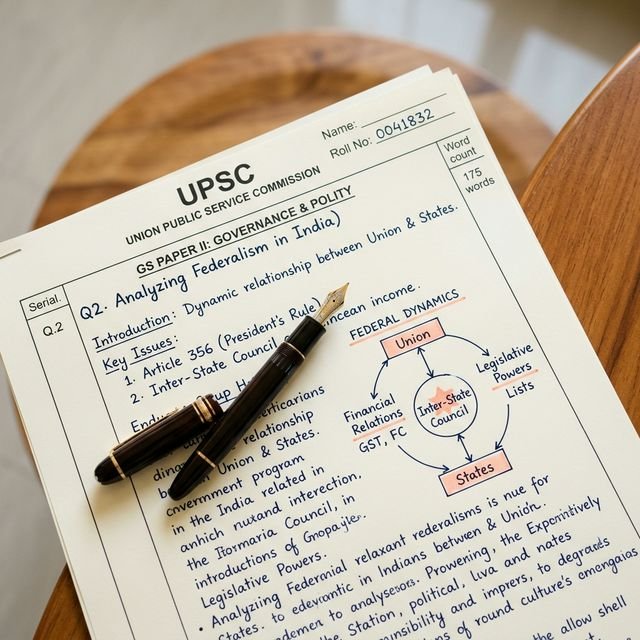
A close look at handwritten essay for UPSC toppers' copies — structure, spacing, and presentation choices that actually earn marks in the 250-mark Essay paper.

Master the essay for IAS with the Roundtable Pyramid Method — a 3-part structure covering UPSC Essay format, 2025 topics, scoring criteria and common mistakes to avoid.

An honest, fact-based look at the psir subject for UPSC Mains: syllabus, exam pattern, GS Paper II overlap, success rate data, and who should actually choose this optional.

A model approach to PSIR PYQ analysis for UPSC Mains — paper structure, compulsory-question rules, word limits, recurring themes, and cross-paper linkages explained.

A precise guide to building political science optional notes for UPSC PSIR — the real syllabus, base texts, current-affairs traps, and answer-format discipline that actually raise scores.

The UPSC CSE Mains 2026 DAF window is open from 19 June and closes 28 June 2026. A step-by-step guide to filling the Detailed Application Form, the documents you need, service and cadre preferences, and how to start Mains preparation right now.

The 2026 Iran war shut the Strait of Hormuz — a chokepoint carrying a fifth of the world's oil — and sent Brent crude toward $118 a barrel. For UPSC aspirants, this crisis sits at the crossroads of GS-2 international relations, GS-3 energy security, and Essay.

India concluded a landmark free trade agreement with the European Union in January 2026, and the India-UK CETA enters into force on 15 July 2026. Together they reshape India's trade architecture — essential reading for GS-2 and GS-3.

A precise guide to the political map of India — 28 states, 8 Union Territories, the constitutional basis (Articles 1-4, 239-242), and the live J&K/Ladakh statehood debates.

India is now effectively free of Left-Wing Extremism, with affected districts down from 126 in 2014 to just 2 in 2026. This is a landmark internal security story for UPSC GS-3 — the causes, the strategy, and the road ahead.

A UPSC-focused guide to the classical dance forms of India — SNA recognition criteria, all eight forms, state links, the Chhau debate, and UNESCO distinctions for GS Paper I.

UPSC Prelims Result 2026 declared on 15 June 2026. Download the official roll-number PDF, check your qualifying status, and see what to do after CSE Prelims — qualified or not.

A complete, UPSC-focused guide to the classical languages of India — the 11-language list, LEC criteria, the 2024 revision, and the October 2024 expansion of five languages.

A precise breakdown of the Soil Health Card Scheme's objectives, 12 tested parameters, RKVY restructuring, and measured impact on fertilizer use and yields, for UPSC GS-III preparation.

A precise UPSC guide to the Domestic Violence Act, 2005 — key definitions, reliefs, Protection Officers, shared household rulings, and 2021-2025 case law for GS-1/GS-2 answers.

A UPSC-focused guide to the National Medical Commission's structure, its four autonomous boards, the NExT exam deferral, and governance debates for GS Paper II.

A precise UPSC guide to the National Human Rights Commission - its statutory origin, 2019-amended composition, powers, key limitations, and the 2025 GANHRI downgrade.

A precise, exam-ready explainer on the National Investigation Agency Act, 2008 - its 26/11 origins, scheduled offences, Special Courts, the 2019 amendment, and the live Supreme Court federalism challenge.

A precise UPSC guide to the monetary policy of the RBI — MPC's legal basis, composition, inflation targeting, tools like CRR, SLR, repo, and SDF, plus 2026 rate updates.

A special economic zone is a duty-free enclave for exports. Understand India's SEZ Act 2005, tax provisions, land norms, and SEZ 2.0 reforms for UPSC GS-3.

A curated PSIR optional booklist for UPSC Mains — the essential Paper 1 and Paper 2 books, plus how to actually read them to score 300+. From Roundtable IAS.

UPSC coaching isn’t only about understanding topics—it’s about writing answers examiners reward. Learn the Roundtable framework to structure GS answers with clarity, evidence, and critical thinking.

China controls 90% of global rare earth processing and has weaponised this dominance through export restrictions on 7 critical elements. For UPSC aspirants, this disruption sits at the crossroads of defence technology, supply chain security, and great-power competition.

Drawing on Banafsheh Keynoush's analysis, this article examines how both Saudi Arabia and Iran contributed to enabling the October 7 crisis and subsequently failed to resolve the Gaza conflict — with lessons for UPSC aspirants on middle-power diplomacy.

India ranks 131st out of 148 in the WEF Global Gender Gap Index 2025. Behind this headline lies a web of educational bias, health disparities, political under-representation, and economic exclusion that defines what scholars call 'hollow access.'

With 50% tariffs on most Indian products and critical sectors like textiles facing 61% duties, India's MSME ecosystem — 5.93 crore enterprises employing 25+ crore people — confronts an existential challenge with deep implications for trade policy and economic strategy.

The Union Budget 2025-26 identifies four engines of development — MSMEs, Investment, Exports, and Agriculture — while navigating what economists describe as a 'knife edge equilibrium' between growth and fiscal consolidation.

From the PM Dhan Dhanya Krishi Yojna targeting 100 low-productivity districts to the six-year pulse self-sufficiency mission, Budget 2025 overhauls India's agricultural support architecture. A comprehensive breakdown for UPSC aspirants.